
Sculpting is dimensional, physical, and even touchable (though we rarely get to run our hands over an object).
Michael Naranjo, however, encourages viewers to touch his sculptures. To caress the smooth ebony finish of his bronze figures. To detect the bark of a tree or the wings of a bird. Feeling provides meaning and allows viewers to comprehend mass, form, and shape. For Naranjo, who is blind, his fingers are his eyes, and he has received special dispensation to touch artwork throughout Europe. In 1986, he touched Michelangelo’s David. But there is one piece he would like to see again.
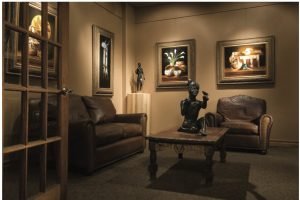
“If I could go back and see anything, it would be The Slave. I would love to touch that one again,” Naranjo told me sitting in Durango’s Sorrel Sky Gallery where he just installed a life-sized work called White Buffalo’s Vision.
Dying Slave and Rebellious Slave at the Louvre Museum are two of Michelangelo’s notoriously unfinished works. Naranjo falls on the side of those who believe that Michelangelo did finish the works. He worked until he felt the need to move on, often learning something in one work that helped him finish another.
“He finished. He did it intentionally. He did what he got done, that’s what he wanted. He simply wanted to let you see what he saw and let you know that it is in there. He gives you a glimpse of what’s inside that stone,” Naranjo said.
That experience, the ability for him to touch these masterpieces, changed the Santa Clara Pueblo sculptor.
“I got a new sense of the stone. I knew there was actual life in these pieces,” Naranjo recounted in a New Mexico television special some years ago. “My hands could ‘see’ before, but after I experienced Michelangelo’s work, I had new life in my hands. I could see twice as much as I could prior to that time.”
Naranjo infused his own work with that tactile understanding. He has sculpted in stone, but primarily works in wax and clay, which are then cast in bronze.
Born in 1944 and sighted until 1968, Naranjo began making sculpture as a child, forming chunks of clay into animals. His mother, Rose Naranjo, is a Santa Clara potter. Growing up in Taos, he spent time fishing, hunting, and exploring the mountains and canyons with his nine siblings. After high school, he attended New Mexico Highlands University but was drafted in 1968 and sent to Vietnam. Caught in an ambush, a grenade explosion took his sight and damaged his right hand. But while recuperating in Japan, he asked for some clay and began making small figures. When he returned to New Mexico, he learned to live alone and kept sculpting.
“My first love was sculpture,” Naranjo said. “It’s always what I wanted to do. I was fortunate in that my left hand was preserved to allow me to be able to do this. I discovered early on that with my mind’s eye and my one good hand I could still make pieces. I was thrilled.”
Naranjo works alone, with no assistants. There is no doubt that his sculptures are from his vision, his hands, his creative endeavor. He sometimes utilizes live models in creating figurative works and prefers wax to oil or water-based clay because it’s lighter and can be constructed using thinner armatures. He uses only his hand and his fingernails when working with pliable materials – no tools that other sculptors use to create fine details, because he doesn’t know what is happening at the other end of the tool. He does use a pneumatic hammer to carve stone, holding it in his damaged hand and feeling his way with his left hand. He’s cut and injured his fingers many times.
Naranjo is sublime, and his works convey an inner life and a soul. Naranjo enjoys reading while he is sculpting, and he will often see visual imagery inspired by stories and dialogue. Or they will come to him in dreams and visions. He believes the stories add to the life of the work, giving them a yesterday, a today, and maybe a tomorrow. I ask him about the man, sitting cross-legged, holding an arrow: White Buffalo’s Vision.
“He was out hunting and saw a herd of buffalo from a distance with a white buffalo. He goes back and finds what he thinks is the perfect arrow shaft, then finds the perfect arrowhead, and a special kind of feathers he puts on his arrow. He’s just finished it. He’s looking down the shaft to see if it’s true and if it will be what he needs when he goes and finds the white buffalo.”
In the sculpture, the eyes of the warrior are not defined, a detail Naranjo incorporated in his work long ago. Both of his eyes were enucleated after the accident, and he was fitted with prosthetic eyes. When the doctors asked him what color he wanted, the man born with brown eyes asked for blue ones. They are striking with his dark skin and silver-black hair. They sparkle and are almost real because his presence is so powerful, his energy so engaging, his passion for life and for sculpting so effusive.
And it is this conveyance of love and happiness that Naranjo suffuses into his work.
PUBLISHER’S NOTE:
Republishing a Winter 2011 Arts Perspective story on Michael Naranjo
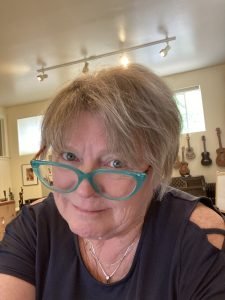 When this story first ran in the winter of 2011, I didn’t know Michael personally. I wasn’t sitting with him or hearing his stories directly—I was simply editing a piece written by Leanne Goebel for the magazine. But as I read through her interview, I remember pausing more than once. His story just stayed with me.
The idea that sculpture could be felt instead of seen… that a bronze figure could reveal itself through touch… that an artist could lose his sight and still trust his hands to guide him forward—that was new to me. It opened up a whole different way of thinking about art and about determination.
I still remember the moment I read the line about Michael touching Michelangelo’s David, and how it changed his understanding of stone. I wasn’t the one standing there, but even on the page it felt powerful—almost unbelievable—that someone could “see” that deeply with their fingers.
Now, all these years later, it feels like the right time to bring this story back. Michael’s daughter has created a documentary about his life, and the trailer carries the same feeling I had back then—quiet strength, curiosity, and a love for creating.
I’m including a link to the trailer here—have a look, and watch for the full release in the near future. Some stories deserve another moment in the light.
— Denise Leslie, Publisher
Arts Perspective Magazine